Eight characters, four pillars
A BaZi chart arranges birth information into four pairs: the Year Pillar, Month Pillar, Day Pillar, and Hour Pillar. Each pair contains a Heavenly Stem and an Earthly Branch. Four pairs give us eight characters. These names belong to the traditional Chinese system for recording time, rather than to a set of eight planets or stars.
There are ten Heavenly Stems and twelve Earthly Branches. They combine in a repeating cycle of sixty pairs. The branches also correspond to the twelve familiar Chinese zodiac animals. Your birth-year animal is therefore only one part of the chart. Two people born in the same animal year can have different month, day, and hour pillars.
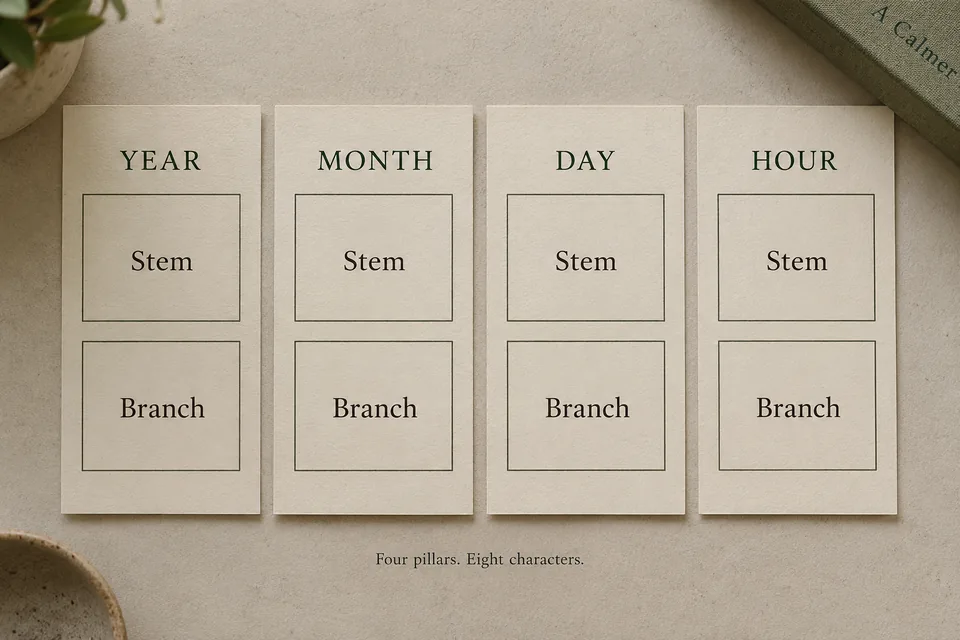
What do the four pillars represent?
Within traditional interpretation, the Year Pillar is often discussed through the lens of background and the wider social world. The Month Pillar brings in seasonal context and is often connected with work and everyday roles. The Day Pillar is commonly associated with the self and close relationships. The Hour Pillar may be interpreted in relation to aspirations, projects, and later chapters of life.
These associations vary across schools. They are interpretive themes, not measurements of your character or promises about particular events. A useful beginner’s approach is to see the four pillars as parts of one composition. Reading a single character in isolation loses the relationships that give the traditional system its structure.
The five elements are also five phases
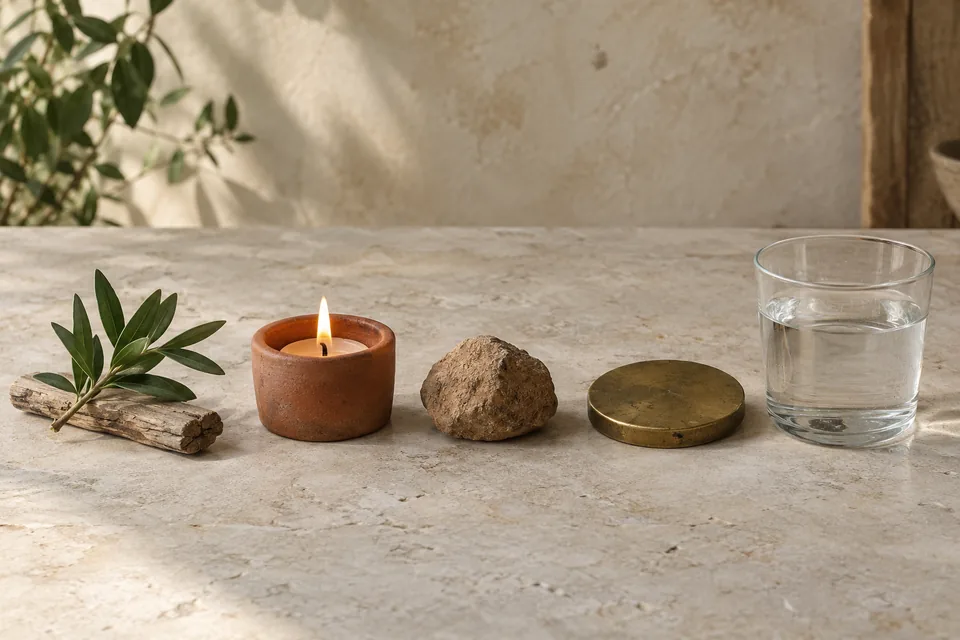
Wood, Fire, Earth, Metal, and Water are central to BaZi. Together they are called Wu Xing, often translated as the Five Elements or Five Phases. “Phases” helps convey that these are interacting patterns of change within Chinese thought, rather than five chemical ingredients. The system describes relationships among them, including cycles of generation and restraint.
For a gentle introduction, imagine Wood as growth, Fire as expression, Earth as steadiness, Metal as refinement, and Water as adaptability. These are illustrative metaphors for reflection, not a personality test. You might use the image of Wood to think about beginning something, or the image of Metal to think about editing and setting boundaries.
The five phases are understood in relation to one another and to the season. Simply counting the symbols does not capture the full interpretive method. Nor does an absent symbol mean that something is wrong with you. A chart can offer a vocabulary for questions; it cannot establish a deficiency in your body, abilities, or worth.
Meet the Day Master
The Heavenly Stem of the Day Pillar is called the Day Master. In traditional BaZi interpretation, it serves as the reference point for considering the other characters. The ten stems express yin and yang forms of the five phases, so a Day Master might be described as Yang Wood or Yin Water.
That label is a starting point within the system, not a complete description of a person. When you encounter a reading, leave room for what does not fit. Your experience, upbringing, circumstances, and decisions matter. A symbolic description is most useful when it opens a conversation you can examine for yourself.
How does BaZi compare with Western astrology?
If you know Western natal astrology, the idea of a chart based on birth information may feel familiar. Both traditions offer symbolic frameworks that people use to explore personal themes. A full BaZi chart is also more detailed than knowing a Chinese zodiac animal, just as a Western natal chart contains more than a Sun sign.
The underlying systems are different. Western natal astrology typically considers planetary positions, zodiac signs, houses, and aspects. BaZi works with calendar cycles, stems, branches, and the five phases. The Day Master is not a direct equivalent of a Sun sign, and meanings should not be transferred between the two systems as if they were interchangeable.
Why birth time and calendar conventions matter
BaZi commonly uses solar terms to define its seasonal months. Many practitioners use Li Chun, the Beginning of Spring, as the boundary for the Year Pillar. This is distinct from the Lunar New Year used to mark the start of the official Chinese calendar year. The traditional hour branches cover roughly two-hour periods.
When comparing charts, check the calculation method as well as the birth date. A calculator should explain how it handles local time, historical daylight saving, and any solar-time adjustment. Conventions around the start of a day can also differ. Births near a boundary deserve particular care. If your birth time is unknown, acknowledge that uncertainty instead of inventing a precise hour pillar.
A thoughtful way to use a BaZi reading
Start with one theme and turn it into an open question. If a reading discusses initiative, ask when beginning comes easily and when you prefer more preparation. If it discusses adaptability, think about a recent change and what helped you respond. Write down concrete examples, including examples that challenge the description. This keeps reflection connected to your lived experience.
You remain free to accept, question, or set aside any interpretation. YunSeer presents BaZi for cultural learning, entertainment, and self-exploration. It is not a scientifically validated assessment and does not provide medical, legal, or financial advice. Important decisions deserve reliable information and qualified support where needed. Our guiding idea is simple: ancient wisdom can invite a clearer look at the present, while your choices remain your own.
Sources & further reading
Calendar references explain the timekeeping foundations; traditional teaching sources describe the system’s interpretations.
- Hong Kong Observatory — Heavenly Stems and Earthly Branches
- Hong Kong Observatory — The 24 Solar Terms
- Hong Kong Observatory — What year is it today?
- Internet Encyclopedia of Philosophy — Wuxing
- Joey Yap — The Basics of BaZi & Ten Day Masters (traditional terminology)
- Joey Yap — BaZi training FAQs (traditional pillar associations)
Keep exploring with curiosity. Your choices remain your own. Read our disclaimer.